Music Section ♫
Welcome to the music section!!! If you know me, you should already know that I really love music, and I'm sure everyone else does too. It plays a huge part of our lives, we see it in movies,tv shows, games, stores, our phones etc, it's literally everywhere! That's why I believe it's something worth learning about. I made this section to share every little thing I know about music. I'm not a music expert or anything, but hopefully anyone reading this will learn something or at least get curious to learn more.
| Contents |
|---|
Music and Emotions
Last edited on August 2024
Why does music make us feel the way we do? Why does sad music sound sad and happy music sound happy? Some people would say it's obviously the lyrics, right? But what about movie soundtracks that sound sad or happy, or classical music? Neither have lyrics, but they still invoke unique emotions. Some people even say most love songs can become creepy stalker songs if you change the soundtrack but keep the lyrics, which is hilarious. So where does the emotion in music come from? Well… you won't get concrete answers from me cause I’m no expert, but here are some of the answers I've found:
-
One thing most people seem to be in consensus with is the association of the rhythm and tempo (“beats'' and the speed of the music) and the heartbeat of a person. When we’re excited or stressed, our heartbeats are faster, and they are slower when we are calm/relaxed or sad. It's not just the heart beats too, but also people's movements when they're in a certain emotional state, have you ever seen a sad person running around saying ‘’yaaay! I'm so sad yippee!!!’’ ? Probably not, sad people move sluggishly and quietly, while happy people are loud and energetic. Hence, sad music is slower and quieter, while happy music is quicker and louder.
-
Another point is that we have been preconditioned to associate certain music with certain emotions thanks to movies, the media and even our childhoods. Some psychologists said it has to do with mirror neurons, which are a type of brain cell that responds equally when we perform an action and when we witness someone else perform the same action, mirror neurons play a crucial role in empathy, imitation and understanding other people. Hence if you see someone sad on tv when ‘’sad music’’ is playing, you'll become sad when you listen to that kind of music, or if you have a song you used to sing in your childhood days while playing or at school it’ll invoke some joy similar to that you felt when you were young, that's my take away at least.One funny example is with Entry of the gladiators which was written to be a military march back in the day, but today it is associated with clowns
-
Another thing is music theory related, and it has to do with scales, a scale is any consecutive series of notes that form a progression between one note and its octave; they tell you what notes you should play to create a certain type of music…I believe I'm still trying to understand scales myself, to be honest. There are 12 major scales and 12 minor scales. Some people say minor sounds sad and major sounds happy but there's always contentions on whether that's the case or not. Then there are chords, a chord is when you play 2 or more different notes at the same time, on a keyboard it would be like pressing 2 or more keys at the same time. And when you do that, the sound can either be pleasant(consonant) or unpleasant(dissonant). Dissonant chords create tension and uncertainty, among other things, and consonant chords create resolution and stability. It obviously gets deeper than that, but that's all I’m qualified enough to explain.
Music and Studying
Work in progress...
Music and Mathematics
Last edited on September 2024
Since maths and music are 2 of my favourite things, I'm always looking for a connection between the 2 and unsurprisingly, there are a lot of them.
- Sound and frequencies
-
frequencies, which is the speed of the vibration and how fast a sine completes one circle, it is measured in hertz or Hz, \(frequency={1\over period}\), higher frequency=higher pitch. A pitch is the position of a single sound in the range of sound.
-
Phase is the moment in 1 circle, represented by degrees or radians.
-
Magnitude, is the relative volume, represented by y values.
- Tuning
Sound is made from vibrations in the air. Vibrations over time are visualised by sine waves. Hence, sound is made from an infinite number of sine waves. The properties of the sine wave are:
Sounds are not just pure sine waves; however, they are made of Harmonics. There's the first harmonic, the 2nd harmonic, which fits 2 times in the fundamental, and the third harmonic, which fits 3 times in the fundamental, and so on… and all of them together create different sounds. The fourier series( \(f(x) = a_0 + \sum_{n=1}^\infty (a_n\cos nx +b_n\sin nx)\) ) and fouries transform (\(\hat f(w) = \sqrt{\frac{1}{2\pi}}\int_{-\infty}^{\infty} f(x) e^{-iwx}dx \) ) are useful when it comes to representing such structures.
In music theory, an octave is a series of 8 notes in a musical scale.
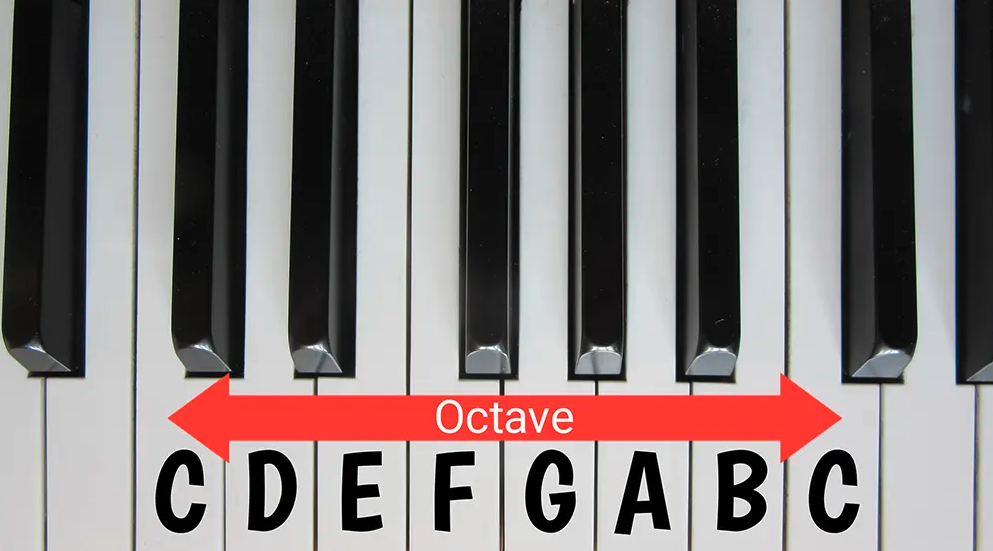
220 Hz-440 Hz is an octave, and 440 to 880 is also an octave in frequencies. 2 notes an octave apart are named the same and sound the same like C and C , but one is a higher pitch/frequency and one is a lower pitch/frequency. From C (left) to C(right), it is doubled in frequency. A lot of physics goes into play when creating a single instrument like the Violin. The length and the thickness of the string matter if you want to produce the desired sound, because the frequencies of vibrations of the strings of similar material depend primarily on the length, the mass per unit length, and the tension force on the string. That's why Violins, Cellos, basses, Guitars, Ukuleles, etc, have distinct sounds.
The first system of tuning was created by Pythagoras when he noticed that different sizes of hammers produce different notes, and that striking them simultaneously created a pleasing combination of sounds. Since it was made by ratios/fractions it was not perfect because of the density of rationals (theres a lot of stories of how pythegoras hated the idea of a \(\sqrt{2}\) ), it misses some notes and creates ‘’the wolf interval’’ which sounds unpleasant. Equal temperament is what is now widely used today. Pianos and other instruments today may sound different from instruments of the past as a result. Equal temperament is done by increasing a note by a semitone is done by multiplying a note by \( 2^{1/12} \). And lastly, Certain ratios discovered by Ptolemy like \( 2 \over 1\),\( 3 \over 2\)… \( 6 \over 5\) and multiplying or dividing them like \( {({2\over 1})\over({5\over4}) }= {8\over5} \) and \( {({4\over 3})({5\over4}) }= {5\over3} \) are consonant, meaning they sound good together, consonant and dissonant intervals are widely used by musicians today.
Understanding classical Music
Last edited on August 2024
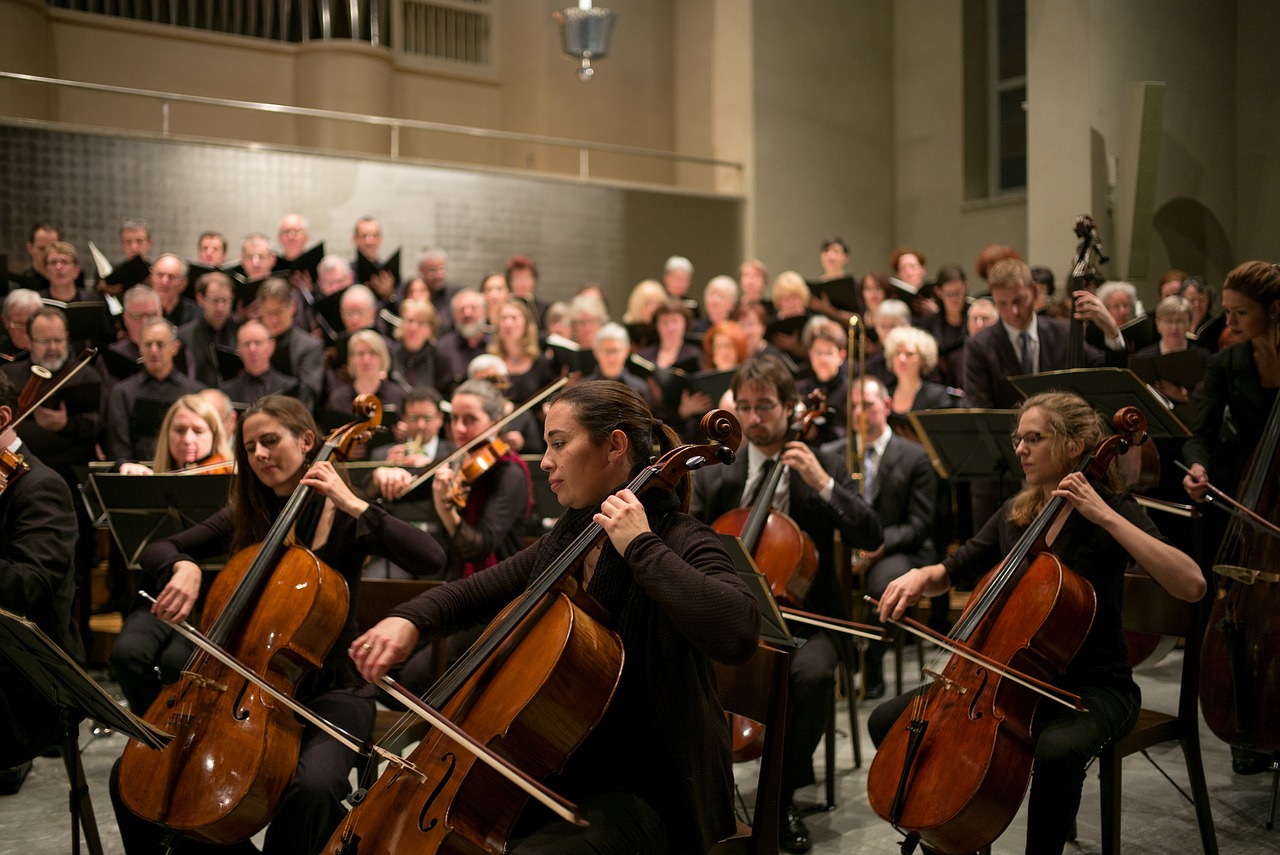
Many people always ask me "Phuluso how do I get into classical music please tell me!", just kidding, nobody really cares about it, which is why I feel compelled to write this, cause I feel like the reason most people don't like it is because they don't really understand what’s happening. People just see a bunch of men and women playing random sounds or something. So here's a list of 4 things you should know.
Classical music gets better the more you listen to it and understand what a piece of music is trying to do. If you listen to a piece just once, then you haven't listened to it at all
Classical music usually in the sonata form, with 3 movements, the first movement is the exposition of the theme, the second movement where the theme is developed and then the recapitulation which is in the third movement, think of movements as like acts in a play, or beat switches in hip hop or something. The funny thing about movements is that some movements are so popular that most people won't even know they're part of a full piece of music and think they're stand-alones. Like with The Dark Knight Rises, who the hell cares about the other 2 films in the trilogy??? (I'm joking).
Another thing worth noting is that there's a different pace in each movement. The conventional pace typically goes 1. Andante(Walking pace), 2. Adagio(Slow), then 3. Allegro(Fast). So if you're listening to a piece and it suddenly feels slow and boring, that means you've entered the adagio(slow segment) which can be a hit or miss. So that's the basics of it. There are some pieces that break away from the typical form, however, and have 2 or 4 movements, Or have a different structure like Beethoven's Moonlight Sonata with the structure of slow, fast, very fast.
Lastly, though not as important to know as the above, every individual movement also has a form of its own, it can be a sonata form(yes a sonata form inside a sonata form), or a Rondo, which is a musical form of ABACAD…the most famous rondo is the Turkish march from Mozart's Piano sonata 11, or it can be a Theme and variations, where a theme is given and variations of that theme follow. A famous theme and variations piece is Mozart's Twinkle little star ★ variations K. 265(there are some people who think Mozart wrote the original melody for twinkle little star but he didn't, he just made variations on it), another famous theme and variations piece is the chaccone which second movement of Bach's second violin partita,another one is Rachmaninov's variations on Paganini's caprice 24, especially the 18th variation because of how beautiful and heavily it sounds. My favourite theme and variations pieces are the first movement of Mozart's piano sonata 11 and the second movement of Beethoven's piano sonata 32. Theme and variations are my favourite thing in music, that's why I gave so many examples.
- Sonatas
- Symphonies
- Concertos
- Chamber music
- Mass
- Suites
- Piano Miscs
A Sonata is a song played by an instrument in sonata form. There are piano sonatas, violin sonatas and cello sonatas, etc. The most famous is the Moonlight sonata, which is piano sonata number 14 out of 32 Beethoven's piano sonatas, my personal favourites are 32, 23,30,28,31, 21 and 14 in that order(I love all 32 of them though) and Piano sonata 32 Op. 111 is my favourite piece of music ever composed. Sonata in B minor by liszt, Chopin's piano sonata 3 and 2 and Beethoven's violin sonata 9 Kreutzer are also great, Mozart's piano sonata 11 K. 331 is also a personal favourite of mine and is the piece that really got me to start listening to classical music after I saw it being played in a show I was obsessed with back in 2021 called Steins Gate.
A symphony is when many instruments are playing in harmony as one, it's kind of like a sonata but with the orchestra as the instrument and the conductor as the player. My favourite are all of beethoven's 9 symphonies, especially the 9th symphony(with Ode to Joy in the 4th movement, which is now the anthem of Europe) and the 3rd Symphony(Eroica), Tchaikovsky 5th and 6th, Rachmaninov 2nd, Mahler 5th, Saint Saens 3rd symphony are also personal favourites of mine.
Concertos can be easily confused with symphonies, but they are different, unlike a symphony a concerto is kind of like of a duet between the orchestra and another instrument, in a piano concerto it's the orchestra and the piano, in a violin concerto it is the orchestra and the violin, and so on.The most popular concertos are Vivald's Four Seasons, Tchaikovsky piano concerto 1 and Rachmaninov piano concerto 2. My favourite concertos are Chopin's 1st and 2nd piano concertos. All 5 of Beethoven’s Piano concertos, especially number 5(Emperor)(Yes, I have a Beethoven bias). Mozart's piano concerto 10 K. 365, 20 K. 466, 23 K. 488 and 24 K. 491.Brahms Piano concerto 1, Paganini's violin concerto 1, and Mendelssohn violin concerto are also great.
Chamber music is music with fewer instruments, like a piano trio, string quartets/quintets, etc, it is music that can be played in a chamber, hence the name. My favourites are Beethoven's string quartet 7 and 14-16, beethoven's archduke trio and piano trio 3, mozart's string quartet 16, mendelssohn’s piano trio 1, haydn's string quartet 3(which the second movement of it is now the anthem of Germany), schubert’s trout quintet and many more. Chamber music is great because it's easier to focus on what every instrument is doing.
Masses are spiritual or religious music, usually sung by choirs. Mozart's requiem is the most popular mass ever, The great mass k.427, coronation mass k. 317, Bach's mass, Brahms’ requiem and Beethoven's missa solemnis are also amazing.
A suite is a collection of short musical pieces which can be played one after another. The pieces are usually dance movements. The most famous and influential suite is The Planets by Holst, most movie soundtracks take inspiration from this piece. My favourite is Jupiter-bringer of jolity from this suite. My favourite suite is Suite Bergamasque by Debussy, it features Clair de lune ,which is one of the most popular pieces for the piano, it is so popular that most people don't even know it's part of a suite. I also like Bach's English suite 2.
The piano has too many sub-categories on its own that it'd take too long to list, but popular ones are:
Ragtime is “piano jazz”, like The entertainer, and many other works of Scott Joplin and Joseph Lamb. Ragtime was looked down upon in the past in America since it was created by black people and wasn't as “tidy” as things like waltzes and minuettes), Ballades(are pieces with a structure of a story, like Chopin's 4 ballades which are some of the greatest piano works ever created, Ballade 1 Op. 23 is in my top 5 favourite pieces of all time), Waltzes(for fancy ballroom dances), Nocturnes(gives you a feeling of the night, like chopin's Op 9 no 2 and the C# minor nocturne ), Etudes(for flexing piano skills), Bagatelles(a simple short piano piece, like fur elise(most overhated piece of music ever!!!) and Beethoven's op 119 set ), Preludes, Minuettes, and probably many others I am still not aware of.
Just like other genres of music, there are different eras in classical music. There's the Baroque, Classical, Romantic and the modern era. The Baroque is more tidy and technical, while the Romantic is more emotionally expressive, and the classical is more simple, and focuses more on melody, while the modern is more innovative and experimental. These are just the basics; however, experts can go in-depth with them. Romantic composers include: late Beethoven,Chopin, Brahms, Tchaikovsky, Rachmaninov, Liszt, Mahler, Prokofiev,Schubert,Ravel, Mandeson, Schuman, Dvorak, etc. Classical composers include: Mozart, early Beethoven,Haydn, Salieri, etc . Baroque composers include: Bach, Handel, Vivaldi, Corelli, etc.
My Music
Last edited on August 2024
⚠ Disclaimer!!! I made all of these for fun, so they may sound a little nonsensical, except Op. 4, I was a little serious when I made that
| Music | Score |
|---|---|
|
Wasted day Op. 4 |
Wasted day Op. 4 Score.pdf |
|
ṱana ṱa goswi Op. 03 |
ṱana ṱa goswi Op. 03 Score.pdf |
|
Hate Sama Op.01 |
Hate Sama Op.01.pdf |
My first live classical music experienceNew
My first live classical music experience
Last edited on 08 March 2026
My classical music journey
As I have mentioned before in previous sections, my journey with classical music began in 2021, when I was watching a favorite show of mine called Steins;Gate. In the show, there were 2 characters that became friends thanks to both of them sharing a love for Mozart, particularly his Piano Sonata No. 11 K. 331. Because I was very invested in the show, I went out of my way to listen to Mozart, so I could relate to the characters more, and before I knew it, my love for classical music became a different passion on its own, separate from Steins;Gate. It became my main genre of music. I particularly liked listening to it as I was studying and practicing math equations, for 2 main reasons: it wasn't too distracting as other music, and it was long, so I didn't have to worry about what to listen to next for a while once I had decided on a piece.
Ever since then, I have always had a dream of one day attending a classical music show live, and on March 5th, 2026, I finally did, after nearly 5 years!!! Why did it take me this long to finally do this? I honestly don't know, I could list a million of excuses as to why, like lack of finances, venues being too far for me to travel at the time, not being familiar with the cities, or because I was too busy. But if we’re being honest, none of those obstacles were ever too impossible to overcome, the simple answer I guess, is that I just simply lacked the resolve.
O5 March 2026
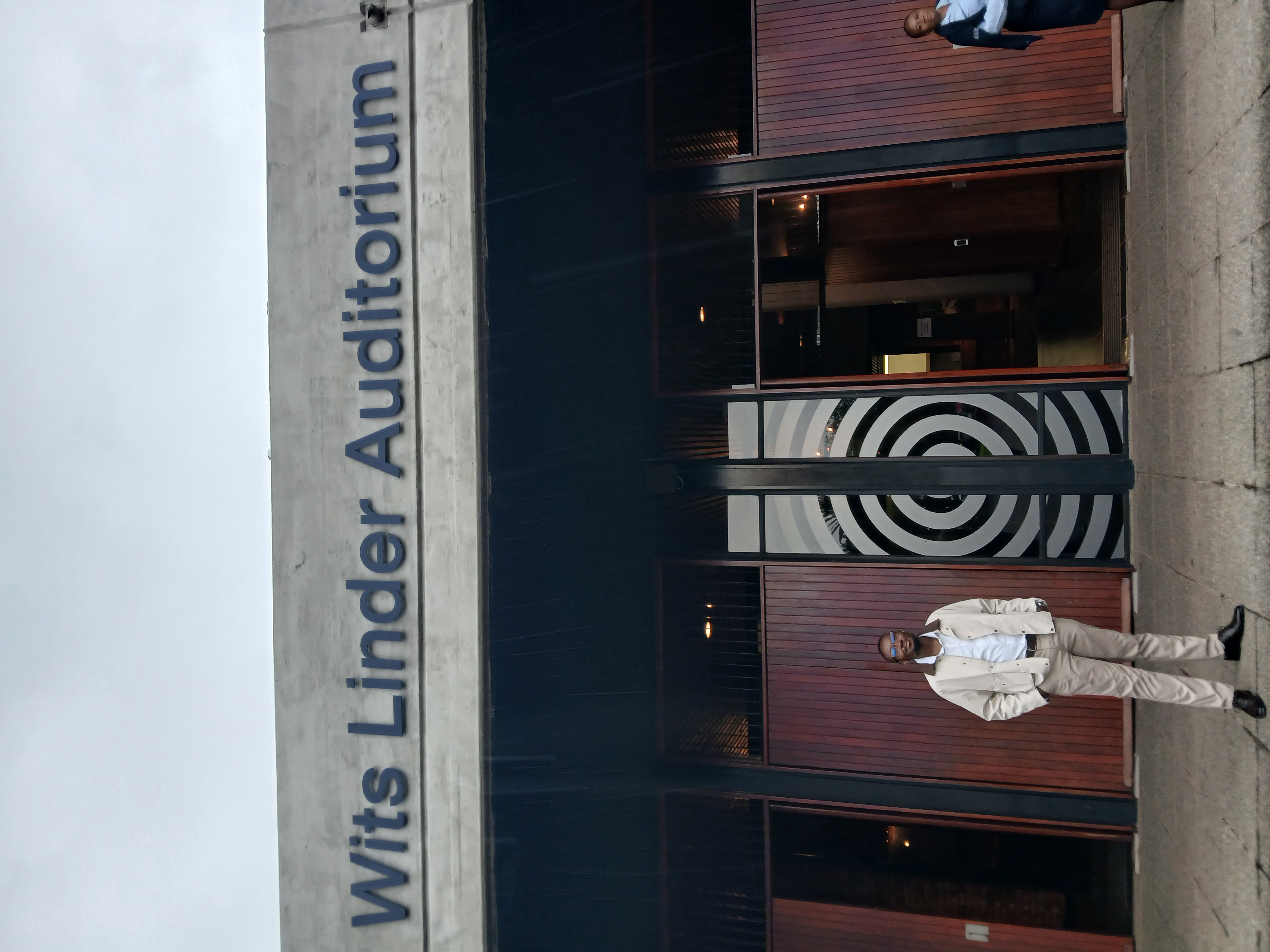
My first live classical music experience was at the Wits Lindor Auditorium, Johannesburg, Parktown, on the 5th of March 2026, the show was at 7:30 pm. I arrived about 2 hours early, one of the first people there, and to be completely honest, at first, I felt a bit awkward and out of place, partly because it was a new environment for me and because initially, the room was full of elderly white people, and I was the only black person there apart from the staff, I did not feel any animosity from anyone whatsoever, just a bit out of place. However, as the auditorium slowly got crowded, I started seeing a few other people around my age and also a few other people with diverse backgrounds, which made me feel less out of place and finally feel at ease.
I had a front row seat, which was my very first lesson from this experience, front row seats are surprisingly not the best when it comes to classical music, it’s cool that you’re so close to the musicians and the music, but at the same time, you can barely see the whole stage, and all the musicians since you’re so close, which explains why front row tickets were the cheapest, I guess that’s what I get for being a cheep skate. It was really nice to see the little things that happen before the show officially starts, like the instruments and seats being set up, and each musician walking to the stage one by one, warming up with their instruments, reviewing their scores, with some of them looking a bit nervous. It was also nice seeing the musicians in person, it gives a way different feel than you get when watching on YouTube or TV, when they’re in person, you get a bit more invested in them, you’ll find yourself focusing on one person in the whole orchestra and wondering how they’re feeling while playing, what’s their life like? What did they do before coming here? Why did they become musicians? And a lot of other things. Another cool thing is that you start seeing the value of the instrument and musicians placements, when you’re live you can hear the Cellos coming from the one side, and the Violins from the other, you can literally feel them clashing or supporting each other, one instrument in the back you weren't paying attention to can suddenly catch your attention in certain segments, it’s also really impressive how so many people can be in perfect sync, something I never saw as a big deal while watching online.
The conductor Conrad Van Alphen, the solo pianist Ludmil Angelov, and the entire orchestra all did a spectacular job. This is how I felt about each piece that was played in the programme:
-
Fraure’s masques et bergamasques: I enjoyed it a lot; it was basically the first classical piece I saw get performed live. It really set the standard for the rest of the show. I wasn't expecting the level of quality I got, but they delivered. I knew I was gonna have a wonderful evening once I heard it.
-
The second piece was Chopin’s variations on Là ci darem la mano, a Don Giovanni theme. This was the first time I heard the piano play live, and it was wonderful. I had recently watched the Don Giovanni opera a few days prior, so I was thinking about that particular scene as I was listening to it.
-
The third piece, arguably the best performance of the night, was Chopin’s Andante Spianato and Grande Polonaise. This piece is very special to me, I have a lot of beautiful memories that I associate it with, I got very emotional as it was playing since I was getting a lot of flashbacks, it was also played very well by the pianist and the orchestra, even if I didn't have that association with the piece, I still would have enjoyed it a lot. It was the piece that got the most standing ovation, I stood up as well, it was well deserved.
After that we got bonus solos from the pianist that were not in the program, it was Nocturne in c sharp minor and the Revolutionary Etude, I particular liked the Nocturne because it captured the mood of the evening very well, I've heard it so many times before but it hits different when it’s being performed live, during the evening, surrounded by a huge crowd of people each with their different stories and backgrounds. I still remember very vividly how the atmosphere was as it was playing.
-
The 4th piece was Beethoven’s 2nd Symphony, now this used to be my least favorite of Beethoven's 9 symphonies and one I used to overlook the most, but after hearing it live, I don't think that’s the case anymore, It’s the piece that had my attention the most because of how masterful it was, I always praise late Beethoven a lot, but that man was a genius throughout his entire life, and this piece proved that to me. I couldn't appreciate it as much when it was on a video because a lot of the intricacies were flying over my head, but when it’s there in your face with your full attention, it’s hard to miss them. This was where I understood why the placement of the instruments is very important.
Anyway, I could say a lot more about how wonderful the overall experience was, but I’ve already yapped too much for one section. My final word of advice is that, go ahead and try that one thing that you’ve always wanted to do; trust me, you will not regret it!
Bibliography
- Rizzolatti, G. and Craighero, L., 2004. The mirror-neuron system. Annu. Rev. Neurosci., 27(1), pp.169-192.
- Juslin, P.N., 2016. Emotional reactions to music. The Oxford handbook of music psychology, pp.197-213.
- Helmholtz, H.L., 2009. On the Sensations of Tone as a Physiological Basis for the Theory of Music. Cambridge University Press.
- Costa, M., Ricci Bitti, P.E. and Bonfiglioli, L., 2000. Psychological connotations of harmonic musical intervals. Psychology of Music, 28(1), pp.4-22.
- Hepokoski, J. and Darcy, W., 2006. Elements of sonata theory: Norms, types, and deformations in the late-eighteenth-century sonata. Oxford University Press.